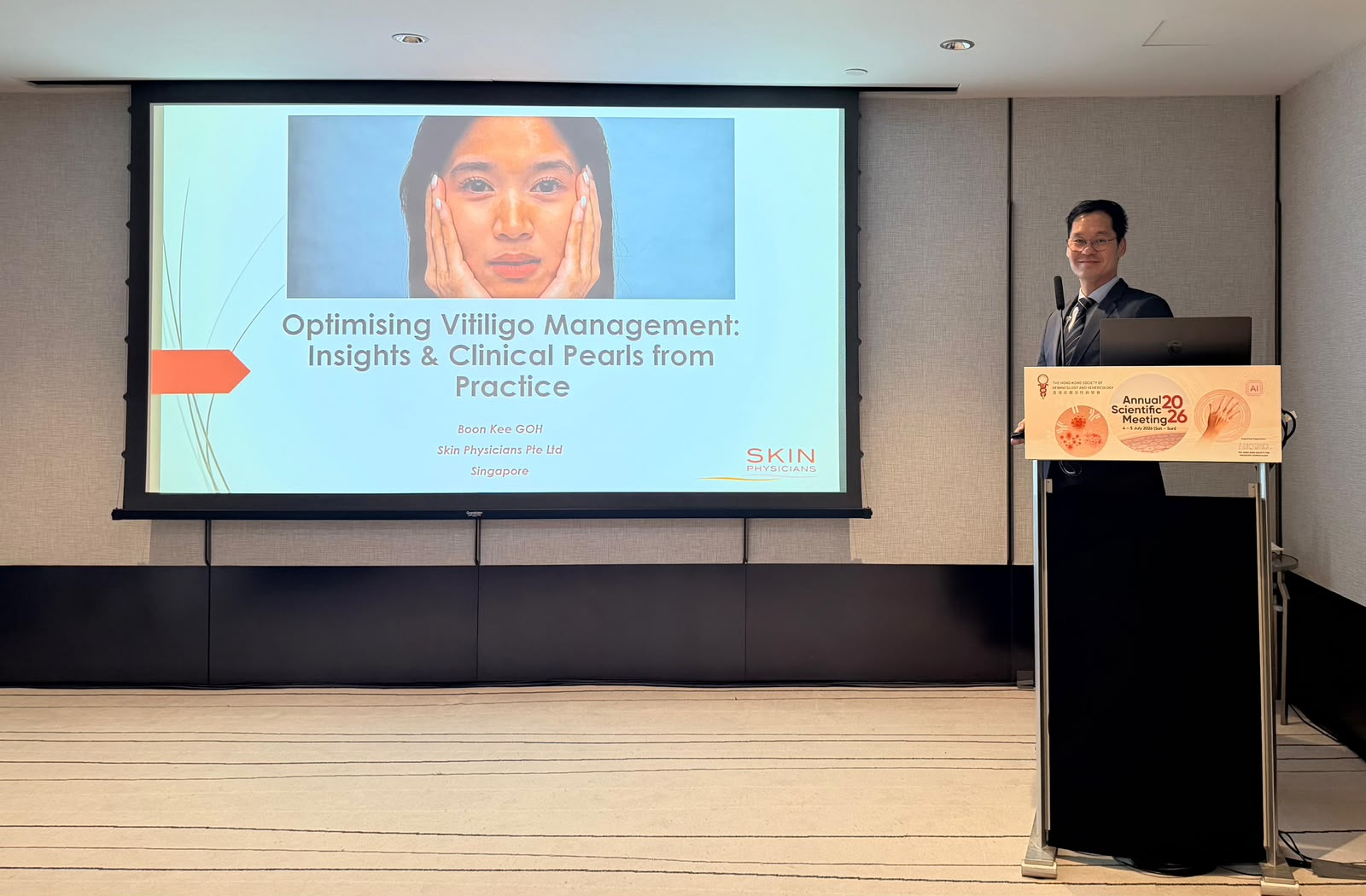
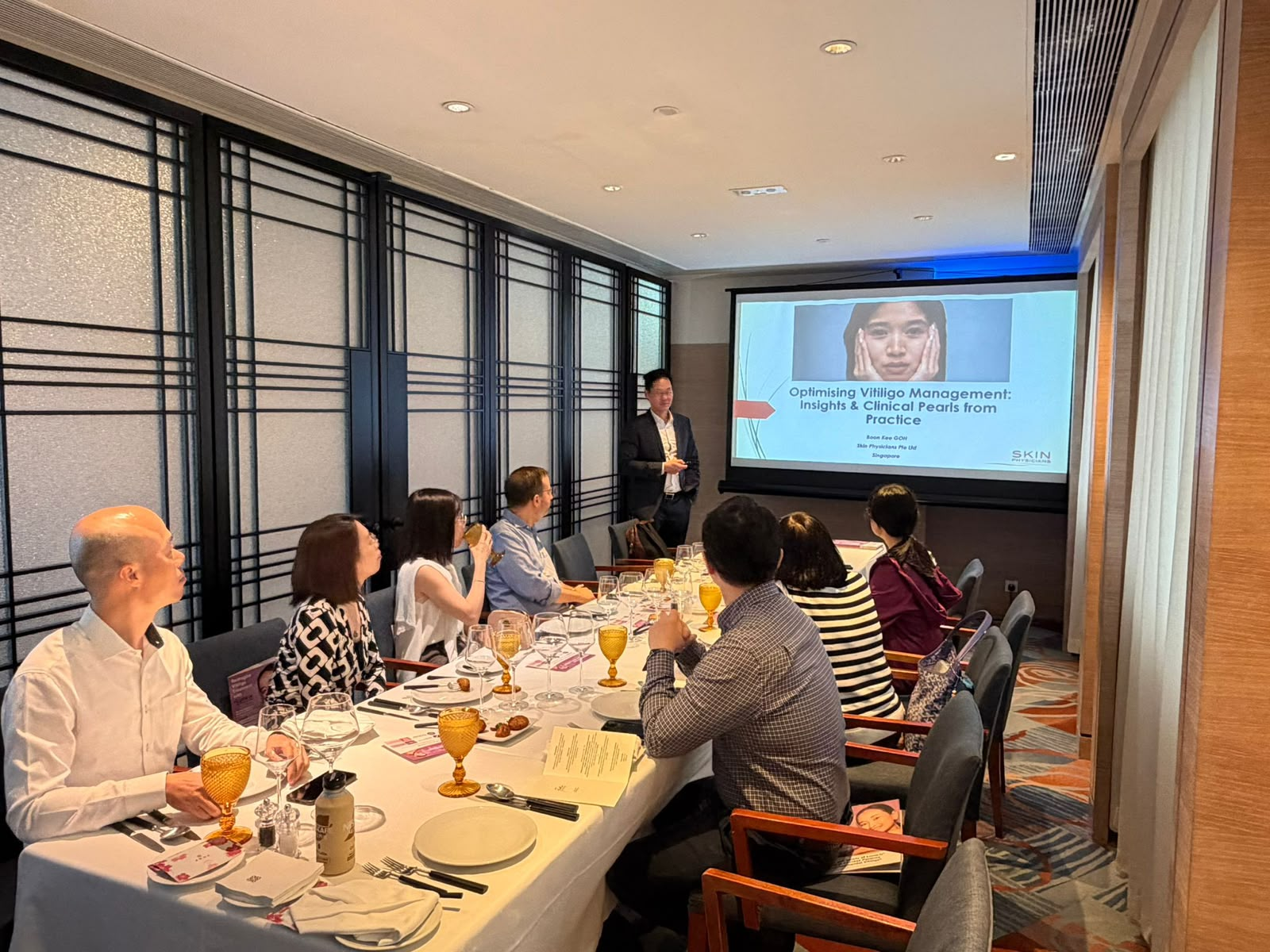
Dr Goh Boon Kee shared his expertise on optimising vitiligo management with the participants at the Annual Scientific Meeting of the Hong Kong Society Of Dermatology and Venereology, held on 4th to 5th July 2026, at the Sheraton Towers, Kowloon, Hong Kong.
In his lecture, Dr Goh discussed the importance of making the correct diagnosis before planning the right treatment for vitiligo. Although it is not difficult to diagnose vitiligo when the lesions have totally lost its skin colour (fully depigmented, therefore white), it can be a challenge when only a few hypopigmented (off-white) lesions are present in a patient. Dr Goh advised that it is important to look for secondary skin changes in this situation, and to examine the patient in full to look for other associated features. Otherwise hypopigmented conditions like the ash-leaf macules of tuberose sclerosis, tuberculoid leprosy, scleroderma, and even patch stage hypopigmented mycosis fungoides can be missed.
Dr Goh Boon Kee further updated the audience on the recent advances made in understanding the pathogenesis of vitiligo, which has opened up new molecular targets for medical intervention. Notably it is now known that the adaptive immunity pathway in vitiligo is interferon gamma driven. Interferon gamma signals through the JAK/STAT receptors that up-regulate the release of chemokines CXCL9 and CXCL20 that attracts CD8 positive T cells from the bloodstream into the skin; these CD8 positive T cells carry out destruction of the pigment cells (melanocytes), and release interferon gamma, thereby generating a positive feedback loop causing further melanocyte destruction.
Because JAK1 and JAK2 receptors are crucial in this process, blocking these receptors becomes a new treatment approach in managing vitiligo. In rapidly progressive vitiligo where new lesions rapidly appear and existing lesions rapidly expand, oral JAK inhibitors in combination with phototherapy (ultraviolet B light treatment) have been shown to arrest the progress. For slowly progressive and stable disease, a new topical JAK inhibitor cream, 1.5% topical ruxolitinib (Opzelura or Lumirix cream) has been shown in multiple clinical trials to be effective in restoring colour in vitiligo. Although the result can be slow, addition of phototherapy to topical ruxolitinib treatment has been shown to increase the efficacy, and bring about more rapid restoration of skin colour in vitiligo lesions. The trials have shown that topical ruxolitinib is safe with very few patients reporting itchiness or pimples at the site of application.
In the last part of his lecture, Dr Goh Boon Kee highlighted that there remains a small proportion of vitiligo patients who, despite all forms of medical therapy and phototherapy, fail to have significant restoration of skin colour, particularly patients with segmental vitiligo. Dr Goh shared his expertise on how to help these group of patients with surgical transplant. Using Non-Cultured Cellular Grafting., he demonstrated that the outcome can be excellent for stable vitiligo as long as the selection criteria has been fulfilled.